Showing posts with label Good Places to Start. Show all posts

Wednesday, December 28, 2022

The Old Gritville Mine: Introduction

I have decided that I am going to take a whack at doing the Dungeon 23 Challenge once the new year rolls around, so consider this the introduction and explanation for my entry.

I will try to post updates (here is the first one) with some regularity, but we will see how that mixes with writing other things for the blog. The description I am going with for the dungeon itself is as follows:

    Known as the Old Gritville Mine or the Haunted Mine, this ancient mine is the original reason why Gritville exists, and also the cause of the worst tragedy in the town's history. About 100 years ago, the miners are said to have uncovered something terrible, warping the space inside the mine into a series of ever-shifting reality bubbles taken from all over the prime material plane. Ever since that haunting day, the entrance to the mine brings people to an unstable world of pocket dimensions which shift and move around inside of the mountain without disturbing the surface. Each bubble of reality seems to consist of 7 rooms at most, which can be of pretty much any size and contain pretty much anything. Because of their motion, these pockets of reality maintain only ephemeral connections to each other. While passages and rooms inside the same pocket reality stay consistent, the hallways that leave and connect to another reality bubble will have new, random locations at the end every couple of hours. Some of these bubbles seem fairly similar to what one would expect from a series of mineshafts and excavated ore pockets, some seem to take people to other planets entirely, many appear to be taken from a much more mundane location, and yet more seem to be the awkward fusion of 2 or more unrelated bubbles.
    Roaming the rooms, hallways, and various pocket dimensions of the Old Gritville Mine are all sorts of creatures. Although it is possible to run into survivors of the original accident, most of them are long dead, usually killed by one of the many horrible creatures from the more exotic reality pockets. Aside from alien horrors, many normal, regular people were also sucked into the mine and a few survived long enough to establish small camps, farms, and even towns in the midst of the broiling chaos of reality bubbles. While rare, these safe havens represent the only thing keeping most who get lost in the Haunted Mine from a painful death at the hands of a terrifying beast.
    Although returning to the entrance of the Old Gritville Mine is nearly impossible because the pocket dimensions are always shifting around, the few who have returned have come back with riches, magic, and powerful objects beyond imagination. While these brave adventurers come back wealthy beyond compare, they also speak of dangers and horrors that they never wish to see again. It is up to each adventurer who hears of the Old Gritville Mine to decide for themselves if they will challenge it. Many have come back with great success, but most have never been seen again.

As far as methodology goes, the first room I make on January 1st will be the dungeon entrance and the only way to enter the dungeon from the rest of the game world. From there, each new pocket dimension will get a theme based on a random adjective and a random location type that I have found generators for. These themes will act as guides for what types of rooms and encounters end up in that particular reality bubble since I will be taking up to a full week for each one.


Monday, October 31, 2022

The Immortal Naturalist's Guide to Cryptic Creatures: Introduction

 Over the past few weeks I have been working on a bestiary of the unique creatures of the world of Tero. I was inspired by cryptids and mythological monsters and thought I would try my hand at making similar creatures. The result is going to be an in-setting document that is suitable to hand out to players should they ever encounter any of the creatures I come up with, and I think it will be fun to make. This is the introduction I made for it from the point of view of the in-setting author of the these entries, Z, the Immortal Naturalist:

    In my many years spent observing and documenting the natural world, I have heard tales of many bizarre creatures in hidden corners of the planet. While most have small but stable populations, I have come across several which appear to be utterly unique in this world. I have always had a fascination with the novel and the unique, so I have taken it upon myself to seek out and document as many of these creatures as I can. This has turned out much easier said than done. Due to their extreme rarity, most of the unique organisms in this book have long been considered mere folklore. Further complicating matters is the difficulty in actually tracking down something that there is one of and that may not even exist. While some of the creatures within these pages took years to even get a glimpse of, I believe that my work has brought us all just a little closer to understanding our world completely.
    Those in possession of this book will find it most useful as a guide to surviving encounters with these creatures, should they ever be so lucky. Each entry is relatively short and will hopefully act as an effective field reference, while more detailed materials should be left at home for thorough studying before and after your encounter. My own illustrations will accompany my notes on behaviors, homes, diets, abilities, and ways to keep them at bay. Admittedly, I did capture some likenesses better than others, and some creatures have more detailed notes than the rest, but that is the nature of these elusive beasts. Even though this work is not comprehensive, I hope this guide will be of use to whoever has it.

Tuesday, August 30, 2022

The Bog Person Confederation: Cultural Profile

This is the cultural profile for the Bog People, the inhabitants of the Bog Lands of Squee and the Damp Plains. I had a random burst of creativity a few months ago and have been working on this off and on since then.

Introduction: The Bog Lands of Squee and the Damp Plains are inhabited by a species of 8-foot tall tall, bipedal salamanders known as the Bog People. Despite what outsiders might view as a crude society with a low level of technology, the bog people have a complex and thriving culture and government which oversees the homeland of the bog people. This matriarchal society is generally peaceful, but invaders tend to meet their ends more than anything else. Bog people seem content to stay in their ancestral homelands, and they seem to want others to do the same.

A typical bog person, holding a trident carved from the thigh bone of a massive bog creature

Magic and Technology: The technology of the bog people is limited by the materials available to them in Squee, but they are masters of the materials they have. Metalworking is entirely unknown to the bog people, and even if it wasn’t, the geography of their homeland makes mining nearly impossible. Regardless, the bog people make due just fine with stone, bone, and reeds. Bog people farm whatever arable land they have available to them, but there is precious little in Squee, so most bog people must hunt and gather for their meals. Hunting and gathering is done with well-crafted and refined tools, even if those tools are made of things readily taken off the ground. Throwing spears and their associated throwers are ubiquitous, as well as stone axes and flint knives. Bog people are also prodigious weavers, having a nearly endless supply of weaving materials in the bogs. Despite this apparent reliance on hunting and gathering, most bog people live in permanent settlements made up of many stilt houses. Stilt houses and permanent residences are necessary due to the frequent flooding of Squee and the somewhat permanent nature of bog person nursery pools, often placed in the centers of settlements. 

Arcane magic is mostly unknown to the bog people, so the main thing that tends to puzzle outsiders is how these permanent villages of wooden stilt houses are made. There are very few, if any, large trees in Squee, so the bog people rely on magic, performed by the matriarch of each village, to grow shrubs into the appropriate shapes to make the houses in a matter of hours. This magic is performed as a religious ritual in reverence to the spirits of the bogs which the bog people must stay in balance with. They maintain this balance by using sustainable hunting and gathering practices and by adapting their communities to fit into the landscape instead of trying to be separate. As long as a village is able to maintain balance with its environment, the matriarch will be able to perform the rituals which channel the power of the bog spirits into creating houses, among other things the community might need. Sometimes, this magic is even used to raise new hills to put nursery pools on, or expand natural ones that are safe from flooding. In times of danger, it is common for the matriarch to raise defenses around her village, and these can take many forms depending on the village and matriarch in question. The most important rule for bog person magic is, however, that it cannot be used to attack, only defend and support the community, making warfare between bog person communities relatively rare, as sieges have an abysmal success rate.


One of the Queen Mothers, eating a meal and holding an ancient scepter said to have the skull of an ancient invader on top

Society: The bog people maintain a matriarchal society where only females who have laid eggs in the nursery pools at least once may participate. For bog people who meet the criteria, their society is essentially a representative democracy. Individual settlements are usually populated by members of a single family, the mothers of which form a council that governs day-to-day life and discusses local policy. The oldest member of this council of mothers is the Matriarch of the settlement, who is responsible for representing the needs of her settlement at her family’s council of matriarchs. The council of matriarchs is where every matriarch of a family meets to discuss issues that affect the entire family and they decide how each village must act to bring about a solution. This council of matriarchs is led by the oldest matriarch of the family, referred to as the queen mother. There are hundreds of families, some of which only control a single village, and each one sends their queen mother to be part of the queen mothers’ council, the body which governs the entire confederacy. Every member of this council is considered to be an equal and has an equal vote when proceedings call for it.

Bog person children never get to know who their biological parents are because all eggs are laid in the communal nursery pond and raised from tadpoles together. Likewise, bog people tend to live communally, with adults freely choosing who to share a stilt house with and regularly changing houses to get to see other members of the family. Reproduction happens once a year when everyone of the proper age leaves home to go meet up with the population of another family’s settlement and have a fertility festival. This is done to avoid the inbreeding that would happen otherwise, and families make sure to meet with a different family every year.

Due to their importance in governing settlements, females of the bog people tend to stay closer to their homes in case they are needed, while it is often the responsibility of the males to range farther and gather food while they hunt. This social order is perpetuated by those in power and many bog people never question it. There are, however, members of bog person society who are unhappy with the division of labor based on biological sex. These people are frequently pariahs in their families, although their attitudes are tolerated to a certain extent.

Around 2,000 years ago, if the oral histories of the bog people are correct, a powerful military invader took over Squee and the Damp Plains, subjugating the bog people. These invaders ruled for 500 years before they were overthrown and removed from the bog peoples' lands. Oral histories attribute this successful revolution to the development of their current relationship with the bog spirits, giving them access to a power they did not have before the invasion. Little is known of who exactly invaded, but all accounts agree that they were a group of snake people, obsessed with secrecy. Because of this secretive tendency, very little information about their one-time rulers ever made it to the bog people. Despite this, the Snake Monarchs of Squee left behind many stone monuments and buildings, all made of imported stone. Many of the monarchs left wondrous treasures and dangerous magic behind when they were overthrown. This has been left to fester for 1,500 years, and many problems for the bog people of today are caused by the things left behind in these ruins.

Other than the physical impacts, the Snake Monarchs have also left a cultural distaste for expansionism and conquest in the bog peoples' mouths. While they are welcoming to outsiders, they will not hesitate to remove anyone who seems to want trouble. The defensive capabilities of the bog people are vast, and no one has been able to conquer them since their revolution.


A freshly hatched bog person will take about a year to grow legs


Religion: The bog people do not have any kind of organized religion or universal spiritual practice. Each settlement and village must find its own way to reach a balance with the local bog spirits and gain access to the magic which lets them grow and defend their communities. Rituals and prayers are not particularly common, as keeping to a certain way of life seems to be the most consistent way to please and work with the bog spirits. The rituals used to perform magic may seem like worship, but they are really just a way to get the attention of the spirits and tell them what to do.


A young bog person who has not yet learned how to walk on two legs


Towns: Individual towns are built and maintained by the matriarchs who are able to channel the powers of the bog spirits. When a new town is founded, the prospective matriarch must first commune with the local bog spirits to understand what she and her family must do to perform constructive magic. Once this is done, the first thing that is built is a large hill with a nursery pool on top, and then wooden stilt houses are grown outwards. Larger, more elaborate houses and meeting places are placed closer to the nursery pool, and the matriarch usually lives on the hill, right next to the pool itself. The process takes about a week, and produces enough housing for all members of the family who intend to live in the new settlement. The maximum size and population of each settlement is usually decided by the bog spirits as part of their covenant with the matriarch of each settlement. Areas that have more food and resources have bog spirits that allow more bog people, although this is not universal. Because a single family usually inhabits a single town, inhabitants tend to work for the greater good of their settlement and family, and there is a generally friendly atmosphere in the stilt villages.


Friday, August 12, 2022

The Cephalus Mountains: Setting Notes

 Introduction: The Cephalus Mountains include the most northern point of the largest landmass of Tero, making them a generally cooler environment that can see snow-capped peaks into mid-summer. Most of the range is densely forested with coniferous trees, although deciduous trees can be found at lower elevations. The entire area is considered the domain of the kobolds, although there have been several waves of attempted human colonization over the last couple thousand years. 


Geographic History: The Cephalus Mountains are primarily volcanic, forming near a fault line which encircles the north pole of Tero. The fault is not particularly active in the Cephalus Mountains these days, but there are still plenty of active volcanoes and hot springs throughout. Earthquakes are also somewhat common in the region, often resulting in landslides. 


The Kobolds: The kobolds are two feet tall, furry, bipedal, and look like an unholy mixture of a dog and a rat, but they are also the native inhabitants of the Cephalus Mountains, as well as the reason why the entire area as well as the plains directly to the south are sometimes known as the Kobold Lands. The first intelligent kobolds evolved in the central part of the mountain range several million years ago, but did not develop beyond simple hunter-gatherer societies until 3,000 years ago with the invention of digging techniques which allowed them to begin building stable underground settlements, leading to the creation of city-states. These cities were generally situated at the tops of major river valleys and could control several miles downriver as farmland and hunting grounds. The governments of the cities were universally authoritarian and collectivist. Individuals had no rights to private or personal property and were required to fulfill whatever role was required of them by the commands of their overseers. While generally harsh, the kobolds doing all of the work believed that it was worth it to repay their debt to society for the resources they used as infants and that they would use when they became too old to work. Due to the recent waves of human colonization, some of these ancient cities are in a state of decline. About half of the river valleys that once supported significant kobold cities have had their kobold populations exterminated or evacuated, the valleys now supporting meager numbers of humans after the armies that did most of the actual conquering have moved on. After several decades of recovery, the displaced kobolds have realized that the humans assume them extinct and are now plotting to retake their valleys. The city-states that never fell also have their eyes on the conquered valleys, hoping to wipe out the humans and colonize the valleys in the names of their cities. These modern city-states are more or less the same as they were 3,000 years ago when they were founded.


Human Settlers: The most recent wave of human settlement was about 250 years ago and involved the hiring of a large army to escort settlers into valleys, force the local kobolds out, and then have the army move on to the next valley, leaving a group of settlers behind. While this was effective, it means that the humans living in these valleys are unable to muster the same amount of force that was needed to take over the valley in the first place. Most humans living in these valleys believe the kobolds to be either extinct or too weak to get their territory back. The human villages support their populations by trading goods found in or derived from the local environment. Each valley seems to have its own unique resources for the humans to exploit. Despite being there for a while now, most humans still see themselves as invaders occupying the Kobold Lands with no strong connections between villages. Each village has needed to figure out its own form of government and industry, leading to many unique settlements and cultures. Technology levels vary, but the closest parallel to the real world would be that of the English colonies in North America during the 17th century. The settlers are often too busy trying to make a living to worry much about religious practice. Although there are several religious orders and many cults found in the Cephalus Mountains, they do not have much affect on the average person's life.


Rough Timeline

  • 3,000 years ago- The kobolds discover how to dig fairly stable tunnels in the rock and this triggers the development of kobold city states

  • 2,000 years ago- the first wave of human colonization in the area meets an immediate, bloody end at the hands of the kobolds

  • 250 years ago- the second wave of human colonization is able to establish settlements in about half of the valleys with pre-existing kobold city-states, although these human controlled areas are still referred to as "Kobold Lands"


Major Factions

Human Settlements- The descendants of the humans who colonized the Cephalus Mountains 250 years ago. These humans are somewhat aware of the danger posed by both the displaced and settled kobolds and generally maintain some kind of defenses. Each settlement is very different from the next, contributing to the lack of cooperation between villages, but they are all united in making meager livings by exploiting the unique resources of the Cephalus Mountain valleys.


Merchants- Merchants travel the Cephalus Mountains, going between the villages trading important supplies for the unique products of each town. They take their goods to ports of trade to sell or trade for new hauls of supplies and begin the cycle again. Their livelihoods are based on the continued productivity of the human settlements so they can usually be convinced to take actions to assist communities.


Settled Kobolds- Settled kobolds are the kobolds that continue to live in the 3,000 year old cities that their people have lived in since they learned how to build them. These kobolds are extremely communal in everything they do with a strict hierarchy with one kobold in charge of everything. The leaders of the city-states see the general weakness of the human settlements and displaced kobolds as an invitation to retake the valleys as colonies of their respective cities. 


Displaced Kobolds- The displaced kobolds are the descendants of the kobolds that were removed from their city-states by the most recent human colonization efforts. While they are still considerably weaker than they were before being displaced, they have gained enough strength to make serious attempts at driving the humans out of their ancestral homelands. In most cases, the underground cities they once called home have either decayed beyond usability or were destroyed during the conquests 250 years ago. Regardless, each group of displaced kobolds is doing its best to maintain the traditions of their city-states until such a time as they are able to restore their ancestral homes.


Saturday, June 4, 2022

The Town of Polip and the Slimewater Valley


General Description

Polip is a small town in a high mountain valley of the Cephalus Mountain Range. The valley is a flat-floored glacial valley about 20 miles long with a stream, the Slimewater, that meanders along the center. Polip is situated along the stream in about the center of the valley, surrounded by the Tentacled Woods on all sides, with a cleared area around Polip. The primary industry of Polip is the trapping and harvesting of Arboreal Octopi, endemic to the Tentacled Woods, for their ink and tentacle meat, both of which have magical properties. The ink can be made into a potent potion of invisibility and eating the meat grants the ability to squeeze through any opening that is at least one square inch in width for a short time. People in the town trade these materials with merchants for most supplies, although there are a few farmers and tradesmen to provide some services. Most of the ~1,000 residents live inside the wooden wall, called the Mantle, that surrounds the town and which has one gate called the Siphon. The town is led by the mayor, Octavia of Polip, who inherited the position from her mother and directly commands the 12 town guards who operate the gate and enforce the laws. Lately, there have been concerning reports that kobolds, once thought extinct in the valley, have been seen in the woods, as well as reports of trading caravans going missing after they leave Polip, only to be discovered days later, skewered on the tree tops.


Adventure Hook

The session begins with the player characters, along with the rest of the townsfolk, being addressed by Mayor Octavia in the town square. She explains that the town is going to experience hardships if the trade caravans continue to be destroyed because no one will want to make the trip if it is dangerous. She also explains that kobolds have been sighted and she needs someone to go to the Kobold ruins at the head of the valley to investigate. Because town guards need to stay in town to do their jobs, she asks for volunteers to come forward to try to deal with each issue. Another group will take whichever job the party doesn't.


What is Actually Going On

The Queen Octopus, ruler of all of the arboreal octopi, is enraged that her subjects are being rounded up and killed en masse by the people of Polip, so she has been ambushing merchant caravans, resulting in the missing and skewered wagons. At the same time, the queen has been feeding rumors to the local kobolds, never fully removed from the valley, that the people of Polip are making plans to drive the kobolds out of the mountains, prompting them to start planning a preemptive strike against the town.


Enemy Factions

The Slimewater Kobolds

Driven into the high mountains at the head of the valley over 200 years ago, the Slimewater kobolds have been living a hard life in a difficult environment. Despite this hardship, their population is recovering and they have sent a group of soldiers, led by a kobold named Kassius, and a priest, named Kubuldikin, to reoccupy the ruins of their ancient headwater city. Most of the city was looted and then destroyed during the initial conquest, so the soldiers have attempted to rebuild and shore up what is left, although they do not appear to have excavated many rooms yet, and what they have done appears to be relatively crude. Kassius' orders are to scout out Polip and hold the forward location for the larger army that will be coming down from the mountains in several weeks' time.

The Queen Octopus

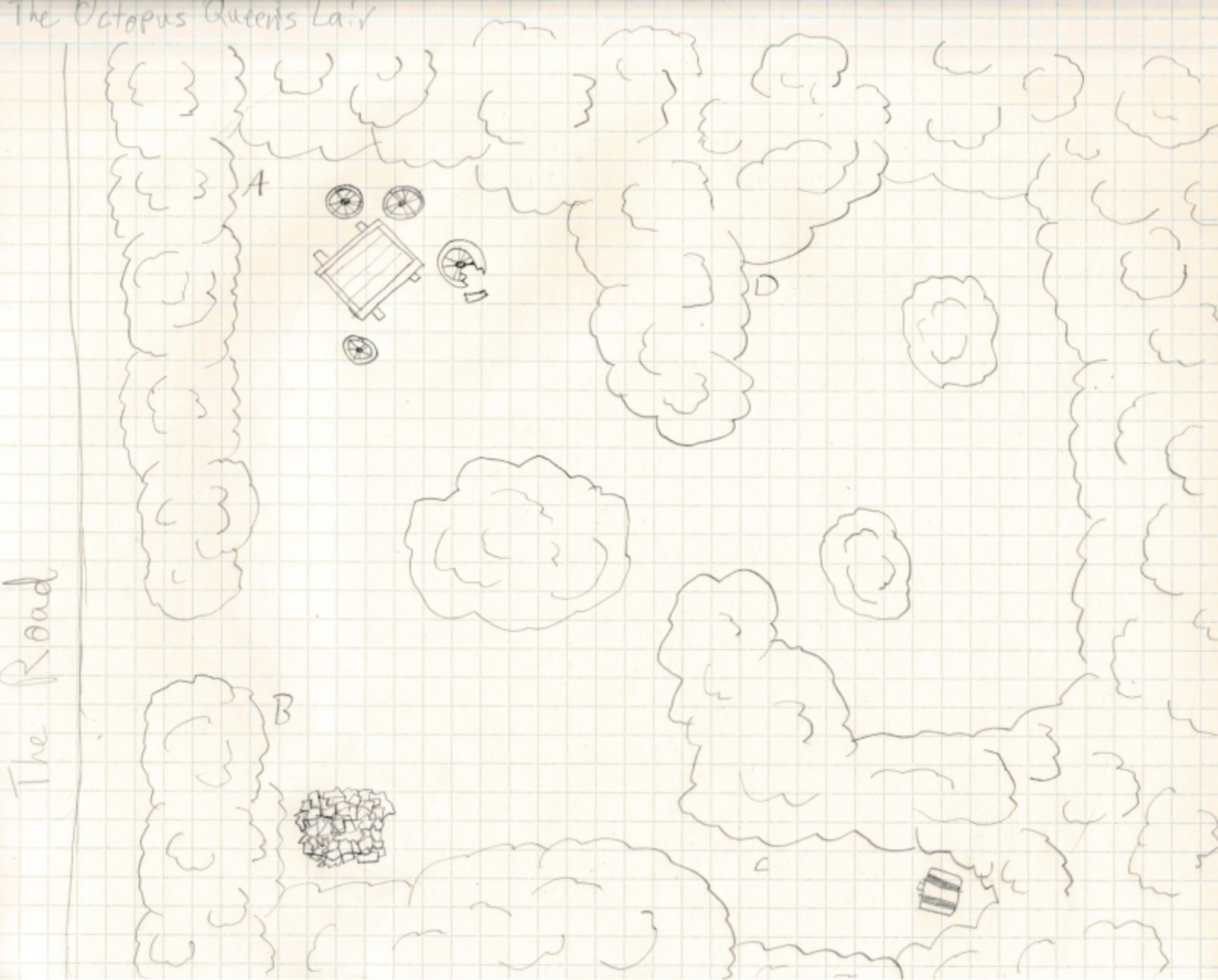
The Queen lives in a particularly dense patch of trees which she has cultivated into several rooms and tunnels leading to a clearing where she keeps her nest. The Queen Octopus must return to this location for at least one hour out of every 12 in order to tend to her eggs. She will defend these with her life. The Queen is horrified at the way her species is being treated, although it is worth noting that only her and the octopuses that hatch from her eggs are intelligent and have the ability to get to her size. She still feels a strong kinship with the smaller arboreal octopi and although she is open to a compromise where she is given offerings in exchange for more humane and regulated octopus harvesting, killing her would also work just fine.


Locations

  • Polip

  • Tentacled Woods

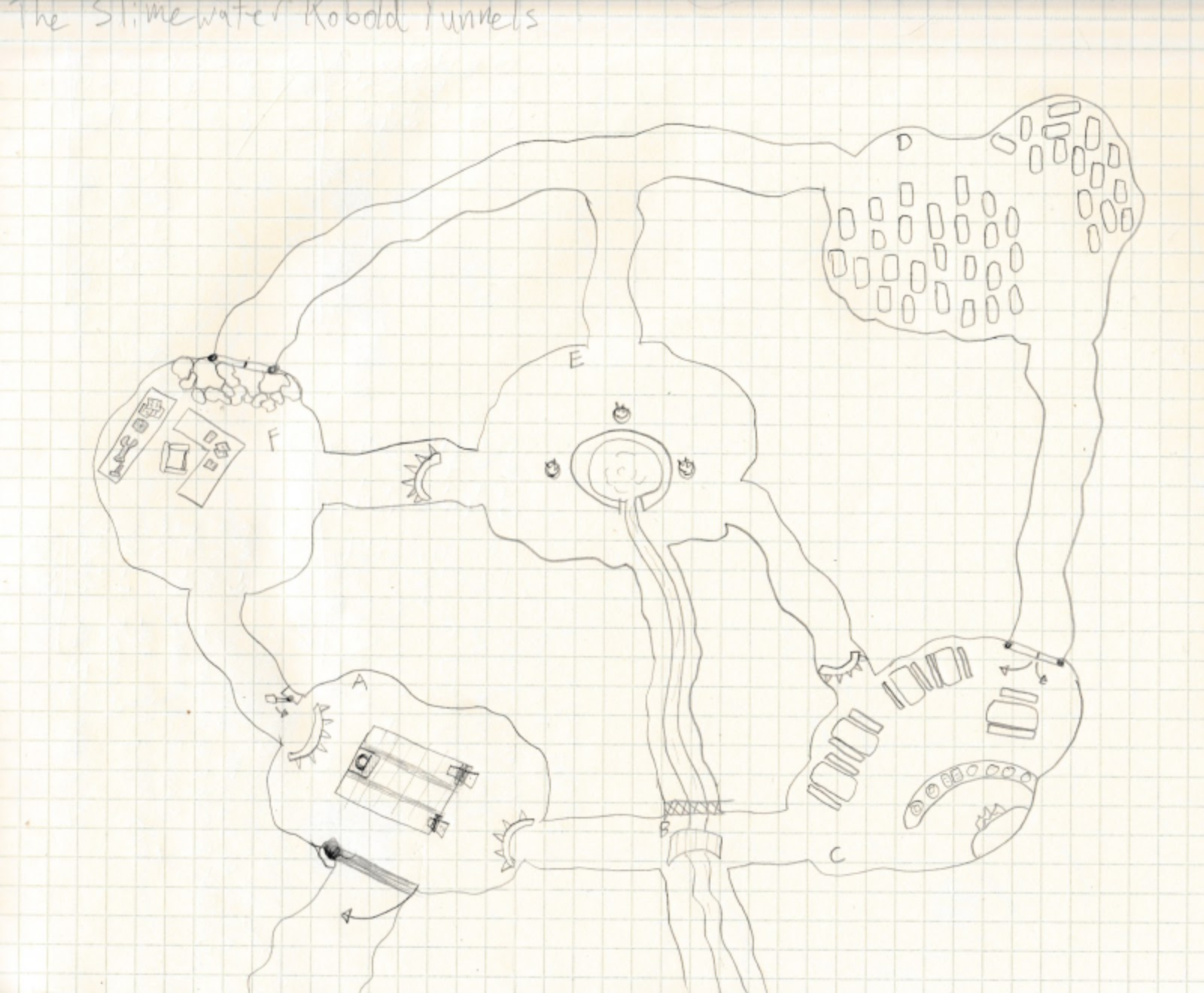
  • Kobold Tunnels

  • Queen Octopus' Lair


The Kobold Tunnels

  • Room A: Entrance Chamber: The intended entrance to the tunnels that the kobolds use. The tunnel leading outside is blocked by a big, heavy gate that takes 4 kobolds to open and at least 2 normal sized people. The gate is made of wood and iron and is locked unless it is being used. To be able to open the gate, there are always at least 4 but usually 5 or 6 kobolds stationed in this room. In the center of the room is a big obvious trap door with no obvious way to open it. There is a lever in the tunnel behind the left barricade that will cause the trap door to fall open when flipped. Beneath the trap door is a 10 foot drop onto wooden spikes. If the players are exploring the tunnels after another group that failed, this trap is responsible for the deaths of all of the previous party's members.


  • Room B: Bridge Chamber: In this chamber, a small bridge crosses over the slimewater, completing the path between the entrance chamber and the mess hall. The slimewater itself has a tunnel leading outside from the headwater shrine. There is an iron grate with bars 1 inch thick preventing people from getting directly to the headwater shrine from this room.


  • Room C: Mess Hall: This room has several tables, a long counter for preparing and serving food, and a big oven. The oven almost always has at least a few embers in it, making this room relatively warm but also smoky and hazy, giving everything that sees with conventional vision disadvantage on checks involving sight. If the alarm has not been called, there are usually half a dozen kobolds in here plus the cook.


  • Room D: Sleeping Quarters: One of the most protected rooms in the area, there are probably a dozen kobolds sleeping peacefully in the various mats and piles of hay scattered in here. Kobolds are very heavy sleepers and these kobolds will only wake up if the fighting spreads to this room or if they are woken up by an alarm.


  • Room E: Headwater Shrine: The center of the tunnels and a place of worship for the kobolds. There is always one kobold priest in here to give guidance to the tribe, tend the three fires on columns that surround the spring, and use the spring for regular divination rituals to hopefully figure out the future.


  • Room F: Kassius' Office: This is where Kassius will be no matter what happens in the rest of the tunnels. He will sit at his desk working on his plans. If the alarm has not been called, there will be two lieutenants in here with him, discussing plans. Kassius has a huge desk with a table behind it, both are scattered with bits of paper, notes, and even a few tools and scraps of metal. Among the notes is a summary of all of the rumors the Octopus Queen has been spreading. Kassius is carrying a note from the main force in the mountains detailing the timeline for their attack on Polip.


The Octopus Queen’s Lair

  • Room A: Broken Carriage: This small clearing has a mostly destroyed merchant's wagon in it. Nothing of value is left of the wagon, although most of the planks of the wagon are still intact and it could theoretically be repaired.


  • Room B: Refuse Pile: This clearing has a pile of waste from the Octopus Queen, her children, and the remains of the caravans she has been attacking. There are 4 of the Octopus Queen's babies fighting over a human femur in here, although they will attempt to run to the nest if anyone walks in on them.


  • Room C: Treasure Clearing: The chest in this clearing contains 6 vials of octopus ink invisibility potion and 10 servings of arboreal octopus jerky.


  • Room D: The Nest: This is where the Queen Octopus rests and tends to her eggs, which hang in large mucus-y sacks that hang from the branches of the trees. There are usually about a half dozen of the queen's babies hanging out in these trees, they will try their best to hide from strangers.


Notes for Running:
    When I have run this adventure, I have the party all take the same mission of the two offered and then have another party of NPCs take the other mission. This party of NPCs will die on their mission, prompting the mayor to ask the party to complete the other mission and also figure out what happened to the other party. I think it is important to note that I run the antagonists of this adventure as being open to talk things out if the players attempt that option, since much of this conflict is based on empathetic motivations and misunderstandings.
    When I ran this adventure, I would change up the numbers of creatures and the amounts of treasure to fit the group, so take those numbers more as suggestions than anything else. I gave one group enough invisibility potions to have all five members be nearly always invisible, and that somehow never got abused, despite that being a fairly low-level party.
    What I like about running this adventure is the opportunity to present multiple moral quandaries to the party without making things too heavy. While the Octopus Queen and her children are intelligent, their complaint is really about what they perceive as unethical and unsustainable market hunting, something that has caused the extinction of many real-world species. All of the other arboreal octopuses are relatively unintelligent animals, so the issue for the party is to figure out what their characters think is a fair solution. As for the kobolds, they are the true natives of the valley and they were driven out of their ancestral homes by the ancestors of the current inhabitants of Polip. The players may very well decide that they do not support the colonists and would rather help an oppressed native people retake their home. On the other hand, the player characters may come from a background that makes the characters more sympathetic to humans and the types of civilization that they are more familiar with. Overall, I think it makes a fun first adventure for a campaign set in the mountains and valleys around Polip.

Thursday, May 12, 2022

The Sea of Treasure: Setting Details

Introduction: The premade islands all share a single setting, the Sea of Treasure. This is a massive, relatively shallow, inland sea with hundreds, if not thousands, of islands inside of it. The entire sea has a warm, tropical climate with little temperature variation throughout the year, although there is a cycle of wet and dry seasons where half of the year, the half analogous to Winter and Spring on Earth’s northern hemisphere, gets more rain than the other half. Years in the Sea of Treasure, and more broadly, the planet Tero, last 365 days and days last 24 hours, resulting in wet and dry seasons that last around 180 days each. Some say that the sea is larger than the area theoretically surrounded by its shores, the beaches of the sea acting as a massive portal to a demiplane of warm seas and islands. Regardless of the truth of these rumors, almost the entire sea is surrounded by land except for two hundred miles where it is open to the ocean at its southernmost point. 

All of the land surrounding the Sea of Treasure was conquered by the First Empire almost 300 years ago, allowing its forces to focus inward on the sea. The First Empire is, believe it or not, the first political entity one could describe as an empire that Tero has ever seen, although it is no longer the only one. The First Empire is led by the First Emperor, a lich who has been in charge of his empire for about 1,000 years now. In recent centuries, the First Emperor has turned his interests to the Sea of Treasure and has started funding a massive colonization effort to conquer and exploit the resources of the many islands of the Sea of Treasure. The First Empire’s presence is stronger on some islands than others, but it is felt to some degree on almost every island.

The real-world historical inspirations for this setting are diverse but centered on themes of empire and colonization. The First Empire takes traits from many historical empires, but the two main ones would be the British Empire during the 18th century and the early Roman Empire. The Sea of Treasure itself takes a lot of inspiration from the Caribbean of the 18th century, but with many less than historical elements added from pulp adventure stories and Pirates of the Caribbean movies to add more fantastic elements. With the information provided, I hope it will be easy to find whatever anyone needs to be able to run games in and easily insert new islands into the setting. 


Cosmology: The planet Tero is one of a potentially infinite number of planets in the prime material plane. This plane is essentially like the universe of the real world with galaxies, solar systems, and planets. On Tero, outer space is referred to as the Outer or Far Realms and it is mostly known for being vast and empty save for the truly terrifying monsters which can brave the void on their own. There are other habitable planets in the prime material plane which have a long history of contact with the peoples of Tero. These other planets, sometimes mistakenly referred to as planes or demiplanes, are home to strange beings who may or may not see life on Tero as worthy of respect. Beings from other planets come in every form imaginable from nearly human to floating balls of energy, and their points of view and senses of morality are just as varied.
    Space travel in the way that we might recognize it in the real world does not exist on Tero yet, but there are many portals, both natural and artificial, between Tero and various planets of the prime material plane. These portals are not always open and may only activate when a certain number of criteria have been met, but unwary travelers have been known to disappear, having accidentally activated a long-forgotten portal to some far flung planet. Creating portals to the other planets is an expensive and difficult task usually performed by the more powerful beings of the other planets than by anyone on Tero. Many of these otherworldly powers have taken an interest in the affairs of Tero and have made incursions onto the planet. Some people see these incursions as a threat and actively hunt them down, but these people are relatively rare.
    As far as actual cosmic planes go, there are five: the prime material plane that was just discussed, Heaven, Hell, Pandemonium, and Order. The planes other than the prime material are the homes of the gods worshiped by the peoples of the prime material plane as well as their underlings and the souls of dead mortals from the prime material plane who move on to whichever plane they were most aligned with in life. There are many theories of the overall structure of the planes and how they interact with each other, but they all agree that there are 5 planes.
    Heaven is the plane of cosmic good and is home to the gods most aligned with the concept of good. The servants of these gods are most often angels and other celestial beings, as well as the souls of good mortals who find themselves in a paradise free from struggle. Hell is the plane of evil and is home to the gods most aligned with cosmic evil. These gods use demons as their minions and tend to find great joy in messing with the lives of mortals. The souls of evil mortals are used as the playthings of the demons of Hell, although mortal souls that gain power and influence can become demons themselves. Pandemonium is the home of the gods of chaos and their whimsical, often traitorous servants, the fey and fairy folk. Souls here often find themselves mixed up in the chaos, but rarely as important actors, more like dead leaves swept up in the wind. Order is home to gods of law and their servants, the modrons. This plane operates like perfect clockwork and anything that challenges this harmony is easily spotted and dealt with. Souls that end up here find themselves incorporated into the harmony of the clockwork, performing some task for the gods of law. There is no plane for the unaligned or the truly neutral other than the prime material, so there are no gods or cosmic beings to fit those cosmic alignments. Neutral and unaligned mortal souls are reincarnated after their personalities and memories are removed, a process that happens naturally when a soul has no strong affinity for any of the 4 cosmically aligned planes.

Geographic History: The Sea of Treasure was, hundreds of millions of years ago, a massive glacier the size of a continent. This glacier existed for a long time, carving out a valley so wide and deep that one would need to view the area from space to be able to tell that it was actually a valley. Eventually, however, the glacier melted and the valley filled with water from the ocean it had once emptied into, becoming the sea that it is today. Since the formation of the sea, many different processes both natural and magical created the multitude of islands in the sea today. Islands have formed in every conceivable way over the millennia, leading to many diverse islands in every shape and size. Although the mainland surrounding the sea remains relatively flat near the level of the water, it quickly rises up to mountains and plateaus within a few miles of the shore in many places.


The Lizard Folk: 5,000 years ago when the first lizard folk arrived in the region, they were part of an influential seafaring culture which established colonies on every habitable island and shoreline of the Sea of Treasure millennia before any other civilization was known in the area. This culture spoke and wrote volumes in its own language and was capable of producing magic items that no one has been able to replicate since.

This civilization was apparently anarcho-communist and stateless in nature, with ancient lizard folk working together more or less of their own free will to build the coral and obsidian cities whose ruins now dot most islands in the Sea of Treasure. The cities themselves acted as centers of trade and production for nearly 1,000 years before a mysterious disaster struck the ancient lizard folk, causing their civilization to collapse. 

In the around 4,000 years since the collapse, all knowledge of how their magical items, grand cities, and spectacular boats were built and maintained was lost. How quickly the lizard folk regressed from advanced seafaring culture to unsophisticated hunter-gatherers is unknown. What is known is that lizard folk today, even those living on islands, are incapable of making or utilizing most technologies or any forms of magic. 

Modern lizard folk appear to be too unsophisticated to be the builders and colonizers they were 5,000 years ago, indicating some kind of species-wide affliction to explain why not a single tribe of lizard folk has retained or even re-obtained any of their ancient technology or magic. In the 4,000 years since their civilization fell, lizard folk in the Sea of Treasure have had no political structure more complex than the simple tribes centered around a few villages that exist today. Of note is that all lizard folk to this day speak draconic and even use the draconic alphabet for some rituals and art. While their past has certainly been mythologized and misunderstood, the lizard folk also have a rich practice of keeping oral histories that go back to before the fall of their civilization in most cases. Each tribe is led by a chief who maintains a council of the strongest men in the tribe. For around 4,000 years these tribes have held their respective villages and fought each other for access to resources. 

The ancient lizard folk did not, apparently, domesticate any plants or animals, or if they did they did not bring them to the Sea of Treasure. This is shown by the lack of any kind of domestic species being kept by or found near any modern lizard folk village. This means that the ancient lizard folk were able to support relatively complex societies with high population densities on either hunting and gathering or some other, unknown method of acquiring food and supplies.

The First Empire has made no formal political contact with any of the modern lizard folk tribes as the lizard folk have never attempted to do anything except eat most outsiders they meet. As such, the First Empire considers lizard folk to be dangerous enemy combatants that should be killed on sight. Contempt for the lizard folk only grows as they occasionally raid towns for supplies. There are, however, many people within the empire who want to have friendly relations with the lizard folk who they see as nothing more than another kind of people.


The First Empire: The First Empire is populated almost entirely by humans, although people of all species are governed by the Empire and recognized as citizens provided they are born inside the borders of the empire or get approved for citizenship. Common is the lingua franca of the empire, although many languages are spoken within its borders. The First Emperor, before becoming an undead lich, was a human man and he still sees much value in the strong wills of living people. The most obvious consequence of this is the fact that while necromancy isn't outright banned, the First Emperor only allows living, mortal beings to serve in his government and military. The Emperor, in addition to leading the government of the First Empire, leads the military, religious, and scientific forces of the Empire as well. He does all of this from his palace in the capital city of the empire, Principolis. 


Magic and Technology: The technology level of the First Empire is difficult to characterize because magic is common enough to be reasonably available to wealthier citizens but not so common that the average worker can afford magical solutions. Studying and performing magic is expensive in the First Empire because schools charge steep tuition fees and spell components cost money if you don’t know where to get them, so mages have a strong incentive to get as much money for their services as they can, pricing out large swathes of imperial society. While magic allows the wealthy to live like current-day wealthy people, the rest of society lives with a level of technology analogous to the late medieval period in western Europe. There are, of course, levels of wealth between these two groups and these different groups can afford different amounts of magic. Some people may not be able to live in modern-day comfort, but they might have enough to afford climate control charms on their homes and healing for most injuries.

The First Empire uses a solar calendar that separates the 365 days of the year into 12 months of 30 days with the 5 leftover days placed after the winter solstice and referred to as Feast Days. On the Feast Days, every single person in the First Empire is expected to refrain from working and instead partake in massive public feasts provided by the empire in the town or city square. It is essentially a 5-day long party thrown by the government with near-mandatory attendance. A sixth Feast Day is added every 4 years as a leap day to keep the calendar lined up with the actual year, much like on Earth. Each month is numbered 1-12 with the first month coming after the fifth (or sixth on leap years) Feast Day. Each month has 30 days, numbered 1-30 in order. Days are also grouped into 5-day weeks with the fifth day of each week considered a rest day for most professions. The thirtieth and final day of each month is called a Festival Day and in addition to being a day off for most people, it is also observed as a holiday of thanks to the First Empire by having all farmers and artisans participate in a market in the town and city squares. Festival days also frequently include music, dancing, and public displays of performance art and theater, mostly sponsored by the local First Empire Temple, in addition to the markets. With this calendar, the equinoxes and solstices, important holidays for the First Imperial Cult, also fall on Festival Days, so those Festival Days tend to have specific rituals and art displays compared to the more general thanksgiving of the other Festival Days. The Spring Equinox is the 30th day of the third month, the Summer Solstice is the 30th day of the sixth month, the Fall Equinox is the 30th day of the ninth month, and the Winter Solstice is the 30th day of the twelfth month and also comes right before the Feast Days of the new year. Various cultures and religions from around the First Empire have their own holidays that they use the Imperial Calendar to keep track of as well, although none of their holidays are recognized in any official capacity by the imperial government.

Boat technology in the empire has advanced much faster than just about anything else, being comparable to the abilities of European shipwrights in the mid-18th century, making wind and paddles the most common forms of boat locomotion, but no longer the only ones. Some of the first magically powered boats are starting to become more common for the most wealthy members of First Empire society, but conventional boat technology still dominates. The First Imperial Navy, for example, still uses mostly conventional sail and paddle boats to get around the Sea of Treasure because magic-propelled boats are generally far too expensive for the navy to operate.

Society: People in the First Empire generally think of their society as a meritocracy. Political positions, professions, and social status are never inherited or passed down, they are to be earned by the individual. The only people who are allowed to be appointed to political positions or even work as bureaucrats in a First Empire Office are those who have passed the Imperial Service Exam, a notoriously difficult test of an individual’s civic knowledge and overall intelligence. Only half of the people who take the Imperial Service Exam every year are able to pass and get approved for government service. Because wealth and property are the only things that families can pass down to their children, the wealthy go to great lengths to ensure their children are able to gain status in their own right while the poor must attempt the same things with far fewer resources, leading to some level of class entrenchment even in a supposed meritocracy. While the truly exceptional can certainly rise up the social ladder, those who start at the top have a much easier time staying there.

Generally, the method of colonization that the First Empire uses is that the navy scouts new islands and establishes camps. These camps act as bases for surveying and exploring islands and often end up becoming forts, towns, and cities later on. Once a certain amount of information has been collected, namely what resources of value can be extracted from the island in question, the Emperor will declare an island open for colonization, at which point people will begin to settle on the island, usually ending up in towns with fledgling industries. Most of the people going to these colonies are those seeking opportunity away from their homes. Everyone has their own reasons for moving to the colonies, but it tends to boil down to one of three things: the opportunity to escape consequences for something, a lack of opportunity at home, or the ability to exploit a known opportunity in the colonies for personal gain. There are other reasons, of course, but most colonists in the Sea of Treasure fall into one of these three main motivations. Some islands have been colonized for nearly 200 years, allowing several generations to live and die on them. Although these people are still considered colonists by the empire, they consider themselves natives to the islands they were born on. There are many people from the mainland First Empire that look down on island-born colonists as somehow disrespectful to their mainland ancestors and origins for embracing the islands.


Towns: Each town is administered by a governor appointed by the Emperor. Governors lead from a First Empire Office that also functions as a town hall and courthouse where residents can seek audience with the governor or go about any other business they have with the Imperial government. By tradition, the First Empire Office has its front door open to the town square of whatever town it is in. Town squares are where important announcements are made to the population, as well as where markets are held, along with most large public events. These towns are mostly left to their own devices so long as they keep producing goods to send back to the First Empire's capital city. As such, each governor is assigned a force of several dozen First Imperial Marines, led by a sergeant, to command and enforce imperial law with. The strength of the garrison can vary a lot based on what the governor requests and what the navy deems necessary. Civilians in these towns usually all work in the same industry except for those who provide necessary goods and services. Living on the frontier without much support from home, governors tend to order their marines to strictly uphold the law and make examples of any rule-breakers. Despite relatively infrequent communication between settlements, there appears to be a sense of rivalry between the towns based on the amount of value generated for the First Empire by each town.


Cities: Cities are like towns in that they are fortified civilian settlements, but they are much bigger and are usually trade and processing centers for whatever region they are in. First Empire cities are led by emperor-appointed governors, like towns, but instead of a garrison of marines, cities have a force of city guards hired from among the population of the city. City guard forces are led by a captain of the guard, appointed by the governor, who usually oversees several lieutenants, themselves overseeing several guard squads. 

The governor and captain of the guard operate out of a First Empire Office much like the leadership of imperial towns, but these offices are often much larger than they would be in towns. Offices must still open their front doors to the city square of the city they are in, but these squares are often just the main ones out of several in a given city. In cities, squares hold similar functions for hosting public events to town squares, but city squares are often more specialized due to there being more than one. City squares where First Empire Offices are located may be called things like first square, main square, or empire square and be centers of government business in the cities. Squares in other districts may be focused on other things like a market for a specific trade, or the cultural practices of a specific ethnic group, while helping to create an identity for the districts they are in.

Cities tend to naturally break up into districts based on geography, culture, and industry. Not all districts in cities are centered around squares, but they all have features that make individual districts distinct from other parts of the city. Smaller cities will usually have only 3 districts, while larger cities can have upwards of a dozen before the First Emperor will force the city to split up into several smaller cities with new, less powerful governments.

Port cities often have an Inspector General who is in charge of the port, docks, and associated warehouses. Port inspectors, as well as keeping order on the docks, are in charge of checking ship manifests and inspecting cargo to ensure it matches the manifest. Cities tend to lack a direct military presence and have relatively large populations, making them hubs of crime where people can easily disappear into the masses of citizens. 


Forts: Forts are operated by marines enlisted in the First Imperial Navy. Each fort is in a location that has been deemed to be of strategic importance to maintaining control of the island. The forts are garrisoned by the First Imperial Marines, usually housing one commander, half a dozen sergeants, and several units of regular infantry. The forts usually have cannons on the fortifications and a fleet of smaller boats at their disposal as well as enough supplies to last at least 6 months in the event of a siege. Left to their own devices with little to do except be prepared to defend the islands, these marines tend to be less disciplined than those in the towns with civilians to keep in line. The forts seem relatively apathetic towards the towns despite being there, ostensibly, for their protection. They also send out regular patrols to see what’s going on in the territory around the fort.


Religion: Part of what helps tie the peoples of the First Empire together is the First Imperial Cult, the state religion of the First Empire. The First Imperial Cult worships the First Emperor as a hand-picked vessel of the collective wills of all gods on the material plane. In this way, the First Imperial Cult is pantheistic, accepting any and all deities and practices into it so long as the absorbed religions accept that the new head of their church and avatar of their god's will is the immortal First Emperor. Religions that cannot adapt to the new theology are wiped out, violently, while religions that accept the new way of things find their practices almost entirely unchanged save for the addition of a few lines paying homage to the First Emperor in their sermons and rituals. All serious worship of the First Emperor and his empire is taken care of by priests of the First Imperial Cult in temples that they build in each town and city under the First Empire. 

Led by the First Emperor, the imperial cult is generally overseen by an archbishop who is the head liaison between the cult and the emperor. The First Emperor has declared that a temple of his cult is to be erected in every town and city in his empire, and the archbishop's primary duty is to oversee the team of bishops who acquire supplies and handle the logistics of organizing such a large organization. Each temple is led by a priest who has a team of deacons to assist them, with priesthoods being bestowed upon deacons by bishops. 

The cult is mostly concerned with spreading the worship of the First Emperor as the avatar of all collective divine wills in the material world, which they do through regular sermons based on the teachings of the emperor and by throwing a festival at the end of each month with special meanings assigned to the Festival Days on solstices and equinoxes. The winter solstice is for celebrating the military might and tactical genius of the emperor, the spring equinox celebrates how the emperor's authority brings new life to previously desolate and wild places, the summer solstice is used to celebrate the abundance that the emperor brings to the lands under his rule, and the fall equinox is when the fairness and justness of the emperor is celebrated. 


Rough Timeline

  • 5,000 years ago- ancient lizard folk settle the area

  • 4,000 years ago- the ancient lizard folk experience a species-wide technological decline, causing their civilization to collapse, the circumstances around this are unclear

  • 1,000 years ago- The First Empire is created as the First Emperor becomes a lich, consolidating the power of the previous federation under one person and focusing the resources of the new nation into conquering its neighbors

  • 300 years ago- The First Emperor begins plans to explore and settle the Sea of Treasure after conquering all of its shores

  • 200 years ago- The first islands are declared open to civilian settlement, new islands are opened every year in an official ceremony


Major Factions

While there are many different groups that people may find themselves aligned with in the Sea of Treasure, it is worth noting that there are some factions that appear to be on nearly every island in the sea. Many of these major factions control other factions, and most people find themselves as members of different factions throughout their lives depending on their goals and resources. 


The First Empire- Led by the First Emperor, this faction is essentially the central government that is in charge of all factions that swear fealty to the First Emperor. The faction is mostly bureaucrats, but they have the ability to access information and give orders on a scale that almost no other faction can. Agents of the First Empire spend most of their time in the capital city and don’t usually have reason to be out in the colonies. Problems for the First Empire are usually solved by sending the navy or directing the nearest governor to do something. Imperial policy and actions are determined by several groups which are all led by the First Emperor. These groups include, but are not limited to: the First Imperial Cult, the First Imperial Navy, the Council of Domestic Affairs, the First Imperial Army, the First Imperial Office of Exploration, and the First Imperial Academy of All Academic Affairs.


The First Imperial Cult- Led by the first emperor and his hand-picked archbishop from Principolis, the individual First Empire Temples are run by priests who have been promoted from deacon by the Bishop of the Sea of Treasure. While the First Imperial Cult tends to exist alongside existing traditions in places the empire conquers, in the Sea of Treasure, where the only native religions are those of the lizard folk, the imperial cult tends to be the only religion with a temple in any given town because they're the only priesthood with a state mandate to build a temple in every city and town in the empire. Some towns were settled en masse by a single group with a shared religion, so those towns will often have a temple to that religion's gods, and cities are big enough that missionaries from other priesthoods will arrive on their own to build temples.


The First Imperial Navy- Led by the First Emperor, the navy is the seagoing military force of the First Empire. The First Emperor keeps a council of admirals that fluctuates in size based on the emperor’s whims. Admirals are promoted from the ranks of ship captains, who themselves are promoted from among the senior ship officers. Naval ships are crewed by sailors, primarily, but the First Imperial Marines are a vital part of the navy that performs nearly all of the actual fighting in naval battles. Similarly, the marines are used to garrison forts and towns in the Sea of Treasure. Due to the heavy reliance on the navy for transporting any military in the area, it is easier to use marines to garrison forts than First Imperial Army personnel. 

Each ship in the navy has its own mission that may be very specific or very broad depending on what the Emperor and Admirals decide needs to be done. Some ships are on missions of exploration, while others guard trade routes, and even more have a list of errands they must perform before they get more stuff to do.


The First Imperial Marines- This faction is more of a common class of soldier than a rigidly defined group with a leader. The First Imperial Marines are the fighting men of the First Imperial Navy and while they are not their own service branch, they are seen as somewhat separate from the sailors and officers on navy ships. Marines are also often deployed as land forces and garrisons in the Sea of Treasure because that is generally seen as being easier than getting the First Imperial Army out there and cooperating with the Navy. The lowest rank in the marines is private, but talented privates may be able to get promoted to lieutenant or even sergeant. On a ship, the person in charge of all of the marines may be either a sergeant or a commander depending on the size of the ship and they are considered a senior officer in the navy with the ability to be promoted to a ship’s captain. On land, commanders are in charge of forts and may have several sergeants to assist them, but the marines in towns are all led by a sergeant who takes their orders directly from the governor of that town.  


Forts- Forts in the Sea of Treasure are under the purview of the First Imperial Navy and garrisoned by the marines. While under the command of the navy, the forts are a political force unto their own on individual islands. As bases of imperial military power, the marines at forts hold many important jobs such as patrolling local waters, settling intercommunity disputes, and acting as bases for military actions nearby. Forts are led by commanders who are advised and assisted by several sergeants while most of the men are regular infantry that perform the daily duties of the fort. Most commanders are interested in presenting the best possible image to their superiors in the navy so they can be promoted to more prestigious commands, regardless of how well they may actually run their forts.


Towns and Cities- The centers of civilian populations in the Sea of Treasure act as important factions unto themselves. Emperor-appointed governors have a vested interest in making sure settlements in their care are able to pay taxes and contribute to the glory of the First Empire and use the influence and control they have to foster that. While each town or city may contain many factions of various sizes, they all form a single community with shared interests as well, often choosing to unite in response to outside threats. The biggest difference between towns and cities in the islands is in not just population, but number of industries as well. Towns tend to have one or two industries that most people are involved in, while cities often have many industries supporting them, including a service industry, while acting as important centers of commerce. 


Wizards- Wizards are a diverse and poorly understood group of people. The study of magic requires many years of intense study and many wizards choose to specialize in a specific area of interest once they reach a certain point in their careers. Such powerful, knowledgeable wizards can apply to be assigned field research positions where their needs are met by the First Imperial Academy of All Academic Affairs while providing the Academy with their findings. While not all of the wizards in the Sea of Treasure are sponsored by the First Empire, many are. As powerful mages with useful knowledge that the other people on the islands can use, all wizards, sponsored or otherwise, have more power and influence than the average person. The interests of individual wizards can be important drivers of island politics as their assistance to local communities is not required by the terms of their sponsorships, assuming they are sponsored.


Lizard Folk Tribes- Each tribe of lizard folk has its own customs and habits, but they are almost always led by a single chief lizard. Each tribe has a village that annual cycles revolve around, but not every member is usually in a given village at the same time. With the exceptions of important festivals, some portion of the tribe is always gone on some mission or errand. While incapable of comprehending the use or construction of tools more complex than rocks and sticks and unable to perform any kind of magic, the lizard folk are still intelligent and capable in other feats of the mind. Despite the apparent primitive conditions the lizard folk live in, they have rich cultures with strong oral traditions and an idea that they were once capable of great things. Each tribe has its own interests and relationship with other tribes, towns, cities, and forts in the area, but the fact of the matter is that bands of lizard folk hunters attack, kill, and eat travelers with some regularity while periodically raiding towns and cities for supplies.


Dragons- Dragons are present all over the world and can have very large territories, so it is not unreasonable to find the odd hoard on islands in the Sea of Treasure. Dragons have few interests beyond feeding themselves and filling their hoards with whatever class of objects they fixate on. While they are not usually concerned with the affairs of people, there is a lot that a dragon will do for a new piece in their collection.